Roots of community - The Orthodox Faith


|
Orthodox means “right glory” (orthi-doxa) in the Greek. It was used since the fourth century to describe a Christian doctrine and a way of life conforming to the Apostolic teaching concerning Jesus Christ and the Church. It is living out the Apostolic witness to Christ daily, that has been shaped and tested through generations of personal and direct experience of the Holy Spirit poured out in the life of the Church.
The emphasis is on continuity and tradition, a holding of the original faith through all ages and in all places. Sharing this common worship, doctrine, ministry and fellowship today are four of the ancient Patriarchates (Constantinople, Alexandria, Antioch and Jerusalem) and various self-governing churches and daughter churches, which were established in Russia, Georgia, Serbia, Romania, Bulgaria, Cyprus, Greece, Albania, America, Finland, Japan, Byelorus’ and Ukraine. There are an estimated 250 million Orthodox persons in the world today. In Canada there are approximately one million, including Greeks, Serbs, Ukrainians, Bulgarians, Antiochian Orthodox, Syrians, Romanians and Russians, and those whose ancestors form the subject of this exhibit, the Orthodox Church in America, now numbering approximately 77 parishes and monastic communities across Canada from Victoria to St. John’s, Newfoundland. Orthodoxy is a universal, apostolic faith. It is one to which even Western Europe can trace its roots, as it was Orthodox for more than a thousand years. St. Patrick of Ireland, for instance, is a much-revered Orthodox saint, whose memory is celebrated on March 17 on the Gregorian Calendar (which is the same as March 30 on the Julian Calendar). Unlike the West that in its various parts passed through a period of Renaissance, Enlightenment, the Protestant Reformation and Counter-Reformation, much of the Orthodox East was subject to the rule of the Ottoman Turks, and was not influenced by these factors. Instead the emphasis was on holding fast to the faith, teachings and traditions in the face of centuries of repression. As such, it has maintained its unbroken historical and theological connection to the New Testament Church. |

|
The Holy Orthodox Church
The Holy Orthodox Church possesses a Priesthood of unbroken succession from Our Lord and Saviour Jesus Christ. Her Liturgy is that of St. James of Jerusalem abbreviated by SS. Basil and Chrysostom. Her Ceremonial is that of the Ancient Church, though well adapted to modern times. She numbers about one hundred and twenty-five millions of Christians, who are under the four Ancient Patriarchates of the East and the Holy Synod of Russia. In the United States besides the Russian, Syria-Arabic and Serbian Clergy, there are several Greek Priests, who are under the Metropolitan of Athens, but who so far as Episcopal Ministrations are concerned, call upon the Orthodox Archbishop of North America. The Holy Orthodox Church recognizes but seven General Councils, and while holding inviolately the Catholic Faith as taught down to the close of the Seventh General , she is not in union with the fifth Patriarchate, namely, the Roman Catholic Church. She holds out a loving hand to all who believe the Ancient Faith, whether in the East or West, and practice it, and who accept the Holy Scriptures as the Word of God. Her continual prayer is for the Unity of Christendom. Holy Tradition The living consciousness of the Church, its continuity with the Church of the Apostles lies in Holy Tradition, the beliefs and practices upheld by the Orthodox, in keeping with Biblical meaning and symbolic Christian truth. The Orthodox Church is rich in holy tradition, beliefs and practices passed from one Christian generation to another. These include important tenets, such as the ever-virginity and all-holiness of the Virgin Mary, who is called the Mother of God, because she bore His Son, Jesus Christ. It also includes the Church’s sacraments. Tradition also includes practices such as triple immersion in baptism and making the sign of the cross, and certain habits, such as facing east for prayer. Doctrine The doctrine of the Orthodox Church is based on Holy Tradition, the Bible, the writings of the Church fathers, who succeeded the Apostles, and the seven ecclesiastical councils held in the history of the Church, including the Council of Nicea (the chief creed of the Orthodox is the Nicean Creed). Despite individual, cultural influences in the celebration of the Divine Liturgy and in the way things are done (rubrics) of the Orthodox churches in various lands, the core of beliefs forming the faith is the same. Sacraments Sacraments, as God’s saving energies in the life of the believer, are central to the faith. A life without the sacraments is seen as a life without God. One of the Church’s key functions is to make these sacraments available to members: Baptism, Chrismation, Marriage, Ordination, Confession, Holy Communion and Holy Unction, and many others. Settlers arriving on a frontier would find the lack of sacramental life incongruous to a life of faith, thus making the establishment of churches paramount. |

| “The liturgy of the Church takes the common created elements of nature and uses them to incarnate the energies of God.
Water, wine, bread, oil, grain, metal, wood, colorful pigments, glass and mosaic tesserae, threads and cloth, wax and wicks, palms and flowers, resins, perfumes…bells all join in a chorus expressing divine grace in the liturgy of worship. The liturgy of the Church transforms the days and the nights, the seasons of time, incorporating them into the Kingdom of God. It knows how to bless oxen and fishing boats, houses and shops, the schoolhouse and automobiles, and to lift up daily food into the sphere of the holy and sacred.” Stanley S. Harakas, The Melody of Prayer |

|
|
Icons
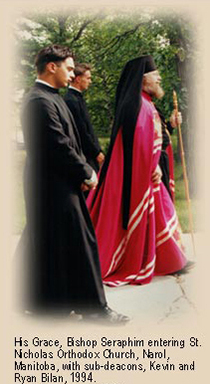
An ancient and holy art form, iconography expresses the truth and vision of the Church: God’s interaction with man and man’s calling as a new creation. Christ’s incarnation whereby He took flesh, allows the iconographer to depict His image. The earliest icons are attributed to the Holy Apostle Luke. Called “windows to heaven,” icons present a peaceful view of God’s grace at work. Varying in size and in medium, the icon might be tiny or cover an entire church wall. They are venerated, not worshipped and adorn the church’s iconstasis (icon-screen), its walls and the prayer corner in homes (svetlii kutochok or bright corner in Russian). Many icons brought to Canada from various parts of the world were copies of famous, miracle-working icons (the Vladimirskaya, Hodegetria, Tikhvinskaya, Iverskaya among them). At present iconographers, both male and female, are adding to the iconographic heritage of Canada. The above icon, at Holy Resurrection Orthodox Church, Saskatoon, was written by Yvonne Romano of Milden, Saskatchewan. Clergy and Laity The ranks of the Orthodox clergy are bishop, priest and deacon. The clergy may be married or celibate, except for bishops who according to long-standing practice, are celibate. Deacons and priest must marry prior to ordination, and once married, are not able to remarry. The bishop, whose ordination can be traced back to one of the original Apostles, is head of the local church and is equal to his fellow bishops. Special titles are given to bishops depending on the size, population and prominence of their dioceses, such as Patriarch, Metropolitan or Archbishop. The Bishop is seen as the father of a large community, which his fond title in Slavic of Vladyka (or Vladiko) connotes.
|