Roots of community - Early Practices



|

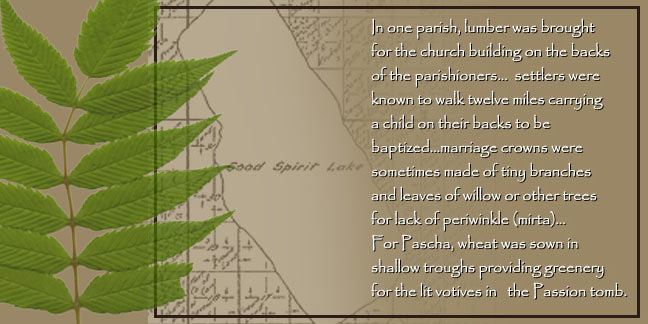
If life is the strength to act, as St. Theophan says, the early settlers were surely alive and strong. They practiced their way of life in harmony with their surroundings, using what their Canadian environment gave as an offering back to God. They blessed the earth, their plantings, their baking, their eating with the sign of the cross made with a rough, work-worn hand. They found time for beauty, too, decorating their rude surroundings with embroideries, often done on burlap bags. Marriage crowns could be created from leaves and flowers, pussy willows abounded for Palm Sunday, and wild Canadian mushrooms took their place among the list of choice, festive foods. Crosses were cut from local wood. Incense from the censers wafted in the fresh northern Canadian air. The environment encouraged prayer: to overcome the hardships of taking to difficult roads between parishes scattered over great distance, getting stuck on muddy trails, bitten by black flies and mosquitoes; there were day to day concerns deciding where how to plough, or where to go when a son got ill…here the faith, the prayers of the pioneers were applied to the life at hand. Already the earliest Divine liturgy was a part of an emerging past, the hallowed spot a place to which to return. The roots of the Orthodox faith were beginning to draw from the soil. Families rode to church on wagons pulled by horses or oxen, which would then be tied to trees until the service (often more when the day was over, as there would be a meal together). Those close enough would walk across the fields with their paska to be blessed. Rudimentary dwellings reflected the faith. An early visit to the Shandro, Alberta settlement in 1900 gives a picture of life in a subterranean dwelling that proved a welcome surprise to the visitor: At 10 in the evening we arrived at the home of a wealthy and gracious Bukovinian, Stephen Shandro. As yet the man had no house or hut, and I was led to a sort of pit covered with earth. Bending low, I descended through a tiny door down steps in a narrow passage which led to the house. But as much as the apartment was exteriorly uninviting, so much it was redeemed by the warmth of the interior. My eyes met a large Russian stove, newly and carefully white-washed. The rest of the room … was completely covered with clean cotton carpets crafted by the versatile Bukovinians. A lamp was hanging on a wall, illuminating the cozy budda, as the Bukovinians call these homes. Benches lined the walls, and these were also covered with rugs. Two rows of kalaches stood white and beautiful on the table. The front corner contained a lighted vigil lamp in front of the icons. At this point the lady—according to the Russian custom—greeted us with the words: We mercifully entreat our spiritual father to taste salt and bread, and all which the Lord has sent to us. The budda was completely given for my use: a suitable tent was already erected for the Service of God, complete with a 3-barred cross and a new table. |

|
They brought many their practices from their native regions with them, including their centuries’ old respect for the aged that determined who proceeded first, who talked first, and sometimes who talked at all! Some had intricate customs that were noted, uniquely Orthodox habits, noted by priests and others. All of these served to enrich the seasons while uniting families with stronger ties.
“Around one hundred children and the same number of grownups took communion. The men came forward first, then the women. Often you hear go ahead, brother Ivan, and the answer, you go brother Kostia, you are older. One of the most known characteristics of the Bukovinian is to ask forgiveness from one another just before Communion. One says to another: I am asking you, brother, for the first time. The other replies, God will forgive you. And the second time? asks the first one. And the second time, answers the one who was asked forgiveness. And so three times."
|



|
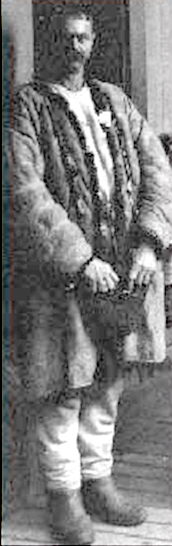
It is evident from church service and family photos that families were large. There were many children in communities, too, with a family on almost every arable quarter-section. Youth was a vibrant dimension, and there were seasons for children, just as for the trees and the birds. Everyone’s life was filled with seasons, and one eye was kept on the weather.
Fall was hard work getting the vegetables into the cellar for winter, helping stook in the fields. It ended when you had to break the ice for the cattle to drink at the slough. Then winter began. As soon as school districts were formed, there was school, but often children didn’t begin until they were old enough to be able to walk the distance, which could be several miles. No one was idle. There was the long winter evenings for reading, knitting, quilting or embroidery by lamplight, much brighter than the original lighting, a wick dipped in oil. Ancestral languages were taught at home in the evening, as in the Derhak family at Sandy Lake. In some families each child had to knit his or her own mittens for winter, or help to make woolen quilts. Or the never-ending peeria-derti (to prepare feathers for pillows by removing the hard central fibre). The patience it took to make one pillow! But there was time for sliding, even if it was just down the haystack or the banks of a creek, and sometimes skating. Spring: when the calves and lambs were born, and the water began to run in the creeks…and summer, glorious for all sorts of fun things, but if was also for washing wool in the lake and hauling hay, for berry picking, and for those near water, swimming. Balls were made out of tightly-wound cow’s hair and then sewed over with a cover, and not called a ball at all, but a “piglet.” “Let’s play piglet!” was the call to the game. |
|

|
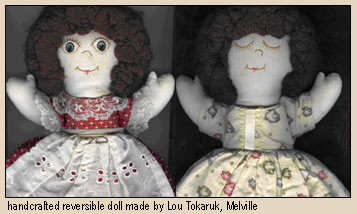
It was amazing what you could make from nothing, scraps of cloth turned into dolls, spools of thread into tops, and what you couldn’t make, you could imagine, and that was even more fun! Hay racks became ships, the cultivated fields the vast plains the first explorers saw, the forest a mysterious, green world etched with secret paths, filled with the sweet songs of the robin and meadow lark.
And what did that bird say? Babushka said it was “Petro-Petro, eta ti? Chi khto?” (Russian) (Meaning, "Peter, Peter! Is it you? Or who?") The frog said, “Borr-rr-sch, Borr-rr-sch!” And his mate answered, “z Bur-ak-ka-ka-mi” “z Burr-ak-ka-ka-mi!” (Ukrainian) (transl. "Borsch! Borsch! With beets! With beets!) |
| Spread the tables with festive cloths! Bring out the bright rugs! Ukrainian Nativity Carol, “Raduisia" (Rejoice!) |

|

|
For some, preparation for the Nativity (Rizdvo, Rozheshtvo) centered around preparation of the Holy Supper on Christmas Eve. The Slavic tradition in many parts was to make kutia (boiled wheat with poppy seed and honey) for Christmas. The wheat had to be cleaned by hand, which was a family affair, separately the wheat from any impurities. The mushrooms specially dried for Christmas (often choice morels) were soaked, as well as the dried fruits to make compote (sushenitsi).
The Christmas Eve meal was as solemn as Passover, eaten with the family, upon the appearance of the first star in the evening sky. Carols (koliadki) were sung at home and were carried from farm to farm in the practice known as “starring,” carolling with a large, lighted star fastened to a pole. |

|
Christ is Risen! Indeed He is Risen!
Then Pascha (Easter). It came with the spring, following the period of Lent, which was preceded by maslenitsa (Butter Day), when pancakes dipped in butter were eaten and then the dairy (and all animal products) were put away for forty days. After a sober Holy Week which included the reading of the twelve Passion Gospels of Christ and the Holy Shroud carried around the Church, it was time for Pascha, celebrating the Resurrection, the most glorious Orthodox festivity of the year. Of course, in the early years with a shortage of priests, not always could a community have the many services of Holy Week. A tradition brought from Ukraine was to gather on Saturday evening and build a bonfire, keeping watch until dawn when the Paschal Service would begin. Sometimes the fire was made in the evening of Pascha. |

|
New beautiful dresses with embroidery were turned out of flour sacks. Ribbons were found for girls’ hair. "Paska" (the Easter bread) was baked and decorated with XB, the first letters of "Christ is Risen" in Slavonic. Those fortunate enough to have a service gathered by horse and wagon, or walking across the fields for the blessing of the pascha. “Christ is Risen!” greeting would be used until Ascension.
It was a tradition to ring the church bells on Pascha, and the whole day long from wooden bell towers, bells would peal across the prairies, echoing through the Orthodox cemeteries with their bell towers, so that, as one reflective settler put it, “even the dead would know Christ is risen!” Anyone could go and ring the bells, especially young people would do it. In the silence that followed the bell’s peal, time would stand still. All was hushed, for Christ was risen, confirmed by the bright spring light and the resumed trill of the birds. Paschal celebrations were not just for a single morning. On Sunday evening, there would be Paschal Vespers if there was a priest. The young would gather on a patch of grass near the Church to sing and visit. Each brought a bit of food, and merry-making would continue for hours. Bright Monday and Tuesday were kept festive, and on Tuesday night, there would be a dance outside, with a home orchestra (anyone who could play) in the centre, and dancing kolomayki, chaban, arkan and the seven-step around the players. For lack of a dance floor, prairie dances were known to be even held on wooden bridges, ready dance floors if there was good weather. It was “come on, Marusia, let’s go, Katrusia!” Everybody danced. It was not a couples’ thing, just everyone having fun. And when the dance was over, no one walked you back to your chair, you just stood somewhere. But what am I saying, what chair? There were none, come to think of it! Everyone just stood around. |
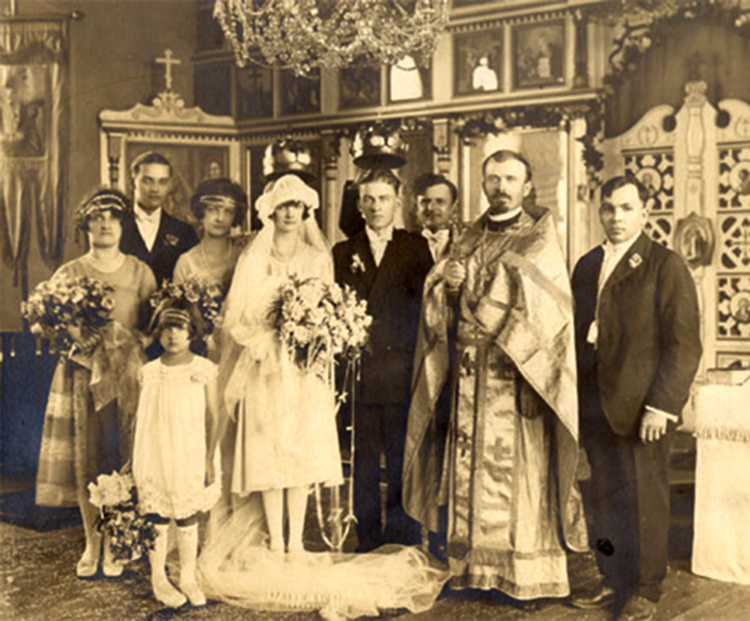
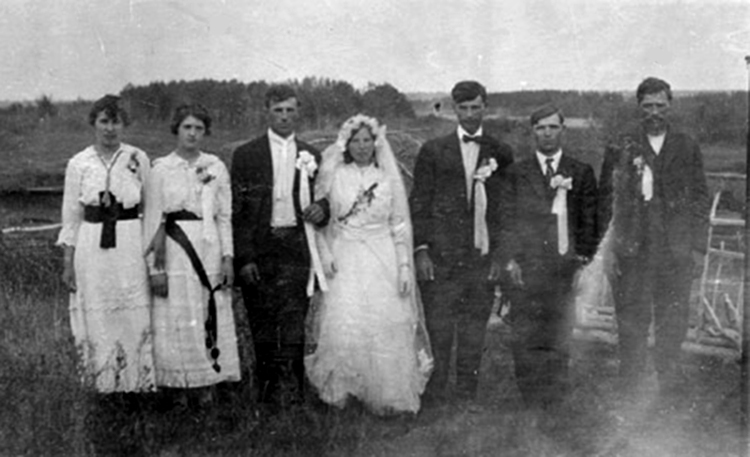
…And there were weddings, held in the summer before which both the bride and groom would walk around the neighbourhood inviting everyone. Weddings with up to 80 families attending were not uncommon. Sometimes the actual sacrament would have taken place several weeks before, when the priest was in the area, then the celebration would follow.
Colorful ceremonies from the Old Country continued: asking the parents’ blessing by kneeling, the weaving of the bridal wreath (vinkoplatinia) with special singing, having a steward (starosta) of the feast, like the wedding in Cana, and the presentation of gifts accompanied by special music by the home-made orchestra.
What of the feast? Involving weeks of preparation, it could mean butchering a young steer or a hog for roasts, sausage, or studenetz (headcheese), big rounds of corn-meal mamalega (kulesha) baked in outdoor ovens, and fresh garden vegetables, green onions with sour cream, salted cucumbers, and wild mushrooms. Buckwheat cabbage rolls were another delicacy.
In the Sheho, Assiniboia district in the early years for lack of other meat, forty big jack rabbits were the wedding feast. “We cooked them up with garlic and onions in an outdoor clay oven. Delicious!” Added to this was a barrel of home-made horilka, brewed from potatoes and wheat, and everyone drank to the health of the young couple, who dwelled for several more years with the groom’s parents in the same house.

Urban weddings could be different depending upon circumstances. Halls, often attached to parishes, were the sites of many decades of wedding festivities, and even many of these continued the tradition of an outdoor clay oven to bake the many dishes that filled the wedding tables.
There were women who were especially good at organizing the meals, and in some districts it became common for “a cook” to be hired. She would come for 3 days before the wedding to supervise the butchering, prepare the meat, and supervise a team of women preparing the food. These weddings were wondrously festive, and young people from every ethnic background would show up to the dance (usually held in an empty granary), walking for miles to get there.