Roots of community - First Churches



While this is not a full list as a number of parishes were already under construction, this list of parishes appeared in Vestnik in 1906, for instance, Sandy Lake, Pakan and Wasel are missing; Vestnik noted that there were several more priests coming to Canada than those shown.

|
Wostok, Alberta – Reverend M. Skibinsky Bukovina, Alberta – St. Nicholas |
Churches began to spring up in the midst of the rural settlements across the prairies. Holy Trinity at Stary Wostok was built in 1897-1898; Holy Transfiguration in Star nearby was built in 1896, but it was not clear whether it was Uniate or Orthodox until litigation in 1902 ending at the Privy Council in London clearly determined it was Orthodox. Regular visits, usually in the summer months, were made by clergy from Seattle in these very early years.
Churches were built by community effort. There were some skilled craftsmen among them, such as Dymetro Skutar of Rhein, who had helped to build churches in Bukovina before coming to Canada. Sometimes local builders could be found: in one case, Doukhobor carpenters were hired. Churches could take years to complete as the settlers cut the logs, hand-planed them and constructed the temple. They were built in various styles: the single dome, three-dome (a particular style from Lviv), sometimes in the shape of a ship (the ark of salvation) and in many instances Bukovinian styles were replicated with squared logs. Trees had to be cut, peeled and in some cases, squared, and chinked with a mixture of straw and clay. Sometimes they were covered with tar paper and siding; others used plaster and whitewash. Inside, V-joint (long and narrow wood board finishing) was used.
Icons were few, and iconostases were home-made. Sometimes icons were surrounded by embroidery brought from Ukraine. Icons were sometimes decorated with beads, as well as embroidery. A wood stove in the centre with stove-pipes running the length of the building was common. Candle holders, icons stands, wooden crosses, and palls for carrying the dead were made from local wood, often carved. In Stuartburn, V. Shidlovsky, a Bukovinian, bought a 50-pound bell rung every Sunday and feast-day across the prairie. Crosses were sometimes made of wood or moulded cement, inscribed with the traditional inscription, "Tut spochivae Rab Bozhii (Raba Bozhia) here reposes the servant of God…."
In the services, besides the English king, often the Austrian emperor and the Russian Emperor would be remembered. With the encroachments of Protestant missionaries and other religious groups, priests also gave Orthodox teachings on Holy Scripture and holy tradition to protect their flock.
In 1904 Father M. Skibinsky arrived in the Wostok settlement and two years later, two more priests, Father Krashitsky and Father Varkhol came to Alberta. The priests lived in the homes of settlers as they visited young parishes. There was so little cash available that parishioners brought seneca root as an offering to the church. That was the wild cash crop of those years, gathered by settlers and sold in the East for medicinal purposes. Sometimes the priests were given livestock (e.g. a calf) for performing a baptism.
By 1905 churches were built, and in some places partially underway at Wasel, Mundare, Stenen, Chahor, Kyselew and Pakan, and the hubs of the West, Edmonton and Winnipeg. Bell-towers tended to be added later, when parishes were more developed.
In this period stately temples were built, such as Ss. Peter and Paul Church at Dickie Bush, remaining even until today the highest church in the Archdiocese.
In 1901 over 800 Paschas were blessed...
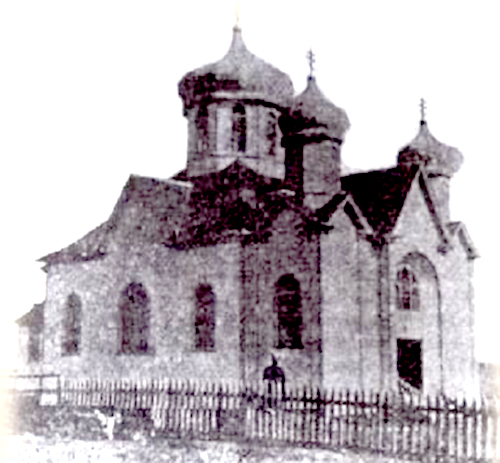
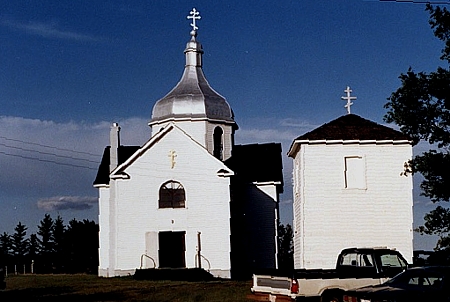
Soon after there were other parishes being formed and churches being built: the Dormition of the Holy Theotokos (Assumption) Church at Shandro, Alberta, St. Demetrius Church, Gardenton, Manitoba and St. Elias Church, Pakan. In the fall of 1900 the first permanent priest was sent to Alberta, Father Jacob Korchinsky. He arrived in the Edmonton area in November, 1900, traveling to Rabbit Hill and staying at the home of Ivan Borys.
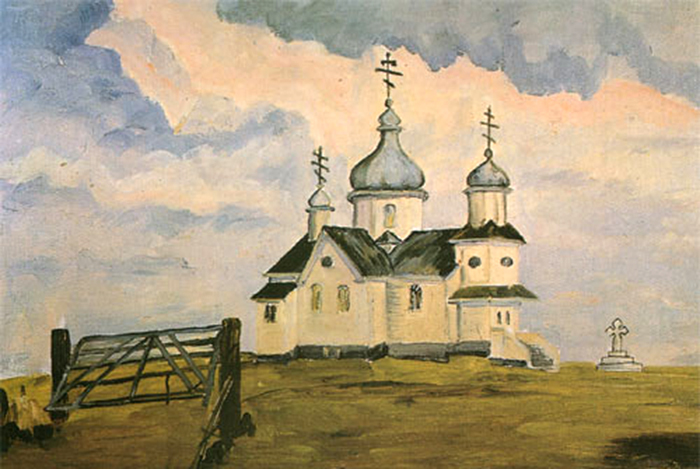
From Smoky Lake History Book, Our Legacy:
…Zaharia Malchean…was very religious and knew how to read and write in Ukrainian and Romanian. Others were Andrew Gidek, Dmitri Cebuliak, Simeon Romanchuk, Nykola Rubuliak, Dodda Ponich, Hrehory Kotyk and Ivan Goryniuk…Gregory Balechowsky, who could do blacksmith work, shaped the iron crosses that were placed on the top of the domes…on the cross of the larger dome, he chisel-stamped the year 1904. By the summer of 1905 the interior was completed and painted, a belfry was built the following year, and bells were bought for $170. Zharia donated the Holy Shroud and two wooden hand crosses with the year 1898 on them; Stefan Kolotyluk and Andrew Waselashko donated the banners, Ivan Strezeboroda gave the Book of Gospels. Ivan Gorda gave a colorful tapestry, Ivan and Nykola Esopenko bought the chandelier…
The church was consecrated and dedicated to the Prophet St. Elia on August 2nd, 1906. Bishop BENJAMIN came from New York and Hieromonk Visarin (Shestakov), as its first priest.

At Holy Ascension, Skaro, the first log church was used until 1920 when it was dismantled and the logs were hauled to a nearby sawmill. Then the logs were sawn into lumber and the new church was built.
Later a bell mounted on a 20-foot high tower made of local fieldstone was added.

From St. Mary’s Shandro, 75th Anniversary booklet:
In May 1899, Stephan Shandro, Nikon Shandro, Semion Hawrelak, Paul Boychuk, George Ostashek and Anton Russ and their families immigrated to Canada and settled in the area which later became known as the Shandro District. This group, consisting of twenty-eight people set themselves to work immediately. Sod-covered dugouts called “burdai” were built for shelter and small garden plots were planted with seeds that had been brought back from the Old Country…More settlers arrived in the fall of that same year, coming from Boriwtci, Zadubriwtci and Ispac, all neighbouring villages of Banilliw. Since all were of the same Greek Orthodox religious faith and all felt the need for a church, they met on January 7, 1900 to discuss this necessity. They met again during the Easter holidays in 1900 and approved the site, SW quarter of section 27-range 15-west 4th for a church and cemetery…In June, 1900, Jacob Korchinsky, a traveling missionary priest, visited the community for three days. He served the first liturgy on the present site of the cemetery, also blessing and consecrating it. Thirty-three children were baptized that day, for people had come from miles around with horse and oxen. In the winter of 1901-1902, the members cut logs and hauled them to the church site…the main carpenter, Stephan Rosychuk, was hired for a salary of one dollar a day, the rest was volunteer labour…by spring 1904 the outside of the church was completed. The inside took several years more and was finished by Stephan Gudzowaty. It was learned that a priest of the Russo Catholic Greek Orthodox Church would be holding a Divine Liturgy at Wostok and arrangements were made for him to visit Shandro. On August 28, 1904 Archbishop TIKHON, accompanied by two priests, arrived and celebrated the first holy liturgy to a full service of worshippers. The church was consecrated, blessed and named after the Most Holy Theotokos and Ever-Virgin Mary.
In 1896, a committee was formed to organize for the procurement of land on which to build a church. On the committee were Mikhailo Melnyk, Mikhailo Pullishy, Ivan Pylypow, Kost Newersky, Ivan Danchuk, Ivan Sorochan and Mykola Spashensky. It was originally built of log and used until 1913, when the church was dismantled, the logs were planed into lumber and the church was rebuilt. The church and cemetery have been declared a historic site.

In 1905, Father Jacob Skibinsky from Wostok visited the parish that had been organizing for two years previously, and plans were made to built a church. Edward Anderson from Edwand was the carpenter, work proceeded until 1909 with much help from all the parish. On a cold day in 1909 the church was consecrated by Bishop ALEXANDER (Nemolovsky). In 1912 a manse was built with a thatched roof where the first priest of the parish, Father Ivan Puchalsky lived (until 1918). A bell tower was added in 1916. In 1928 the church burned down on Holy Saturday, but almost immediately plans were underway for a new one. After the completion of the building the parishioners talked about how Father Andrew Kokolsky courageously lifted the iron cross and elevated to the very top of the high dome, where it was installed and to this day remains a landmark and symbol of Orthodoxy for the Smoky Lake area.
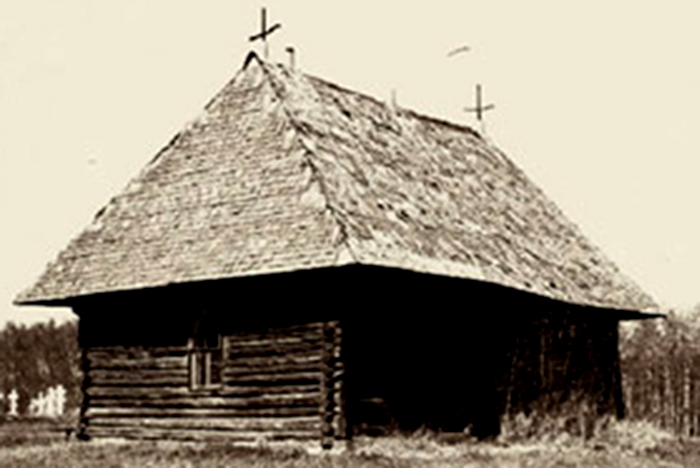
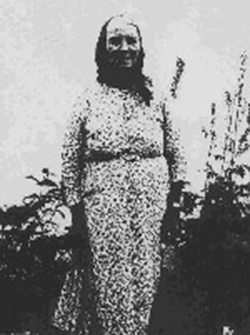
Known as Spring Valley Church, it was built in 1905 under the supervision of carpenters, J. Michaluk and M. Melnyk on NW 10-36-4 W. 2. When the church was being built everyone in the district came out to help, Orthodox, Catholics and Lutherans. The Royal Doors and crosses were made by W. Michaluk, who came from Zastavka, Bukovina. Three years later, in 1908, the Church had to be moved due to flooding, and in time, a new church was built.
In September, 1897, Father Mikhailo Malyarevsky visited the communities in neighbouring Manitoba and Assiniboia, where there were whole block settlements of Bukovinians, who were Orthodox; after that they began to be visited about twice a year. These early visits provided the people with confession, Holy Communion, baptism, marriage and the blessing of graves.
Getting to the parishes was always an adventure. In 1899, Father Kamnev reported a harrowing experience in the Blackmud Creek area during his travels to the Alberta colony of Rabbit Hill:
Nine miles south of Edmonton (Strathcona) a terrible catastrophe occurred: our train while crossing a bridge across the Blackmud River, derailed into the water! Fortunately for the passengers, numbering about 60, the bridge was not very high, only 20-25 feet and the river (more a slough) was very shallow, only about 4 feet deep. The train had 12 wagons, and ours was the very last one, and just ahead was the car with immigrant-Galicians, and they got the worst of it: three of them broke ribs or legs, two of them had head injuries, several women and children suffered. The conductor and train workers suffered a good deal. No one was fatally injured, although the cars and bridge were reduced to absolute splinters! We, thank God, got away with only some serious bruises and a lot of fright, like the rest in our wagon, which by a real miracle, did not fall off the bridge, but just hovered over the edge.
In the middle of the night we returned to Edmonton. For the next two days we felt quite unwell, and spent the whole time in Edmonton, visiting the Immigration sheds, where the ones who had suffered the accident were lying. It seems that two of the Ruthenians who had broken ribs might be crippled from the accident, and the railway company has paid each of them $150. Vestnik, 15/27 August 1899.

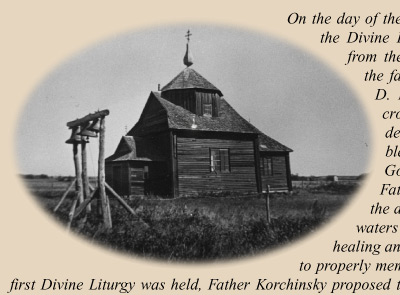


“After about 12 miles, the wagon and horses got stuck in the mud. We got the horses out soon enough but it was not so easy with the wagon. We emptied it out completely but the horses could not pull the empty wagon out. We tried every means, but in vain. Finally, we had to take the wagon apart and put each wheel out separately. We were in the same spot for a whole hour and a half. We went farther. Then we got stuck in the mud again and we were there 40 minutes, until with another strong pair of horses and a pair of oxen we managed to get out.”
In April, 1902 Priest Constantine Popov visited the Assiniboia settlements from Minneapolis. This was not his first visit, as his visit the previous fall was reported in the February issue of Vestnik, at which time he held a long conversation with Doukhobors waiting to catch a train in Yorkton. He had also noted that for lack of cemeteries, many Bukovinians had buried their dead on their own farms, but now at Ounz River, as in other places, they had their own cemetery.
He returned to Saskatchewan six months later, and the following are excerpts from his diary describing his travels and activities – On the evening of the 4th of April I left Minneapolis. Next day, by morning, I was at Emerson, Canada. No one was let off the train until all papers were checked. At Emerson some Bukovinians were already waiting for me with a ride. By evening of that day we got to Stuartburn. I slept on the farm of Tolstovariks.
6 April - I served matins and liturgy in the church that is located on the Hlovatsky farm. There were 43 persons for confession. I spoke on the reading for the liturgy. After liturgy I baptized 3 children.
7 April - same place as yesterday at 6:30 a.m. I served matins, and blessed pussy willows. At 8 o’clock I heard confessions, at the church on the farm of P. Dubniak. There were 132 for confession. At 11:30 I served the liturgy. I talked on faith. After liturgy which finished at 2:30, I baptized 17 children, served a moleben and did two other prayer services (trebi). By then it was 4:30 before the Bukovinians began to depart and I was taken for dinner to the home of the Dubniaks. At 6 in the evening I went by oxen to one or two miles more to the farm of Y. Zachary and there I stayed overnight.
8 April - served the hours and Presanctified, at the same place as Saturday. There were 55 people for communion; I spoke on the sufferings of Christ. After liturgy baptized 3 children. Then we traveled six miles to bless a cemetery. I stayed overnight at the same place as yesterday. Toward evening I began to inquire about a ride so that next day I could leave Stuartburn and at 11, be at Emerson.
9 April - at 2, arrived in Winnipeg. I was met by the Galician, K. …the Galicians who live 35 miles from Winnipeg in the colony of Brokenhead are inviting me to be with them at Pascha. But since I promised to be in Yorkton for Pascha, I told him I could not…but I would try to come to them next time.
19 April - I left Winnipeg at 9, that evening I was in Yorkton. I found a driver who agreed to take me the next day to the Bukovinians 20 miles away.
11 April - at 9 in the morning we left Yorkton, at the beginning the road was quite good, but farther along from Yorkton it got bad, and after about 12 miles, the wagon and horses got stuck in the mud. We got the horses out soon enough but it was not so easy with the wagon. We emptied it out completely but the horses could not pull the empty wagon out. We tried every means, but in vain. Finally, we had to take the wagon apart and put each wheel out separately. We were in the same spot for a whole hour and a half. We went farther. Then we got stuck in the mud again and we were there 40 minutes, until with another strong pair of horses and a pair of oxen we managed to get out and continue our journey. At 10 at night we got to the farm of Bukovinian, Skreliuk. There were 15 Bukovinians gathered there. Served matins and read the Twelve Passion Gospels.
12 April - at 10 in the morning, did the Hours. Presanctified Gifts, with 27 persons present. Baptized 1 child. At 4 served Vespers. There were 25 worshippers.
13 April - Holy Saturday. Served matins and liturgy, there were 44 for Communion….after the liturgy, blessed paska, baptized 4 children, chrismated one child. At 2 left for the colony at Tetlock. Got there at 9 and stayed at the farm of D.Yastremsky, where I was last fall.
14 April – Pascha. At 6 a.m. 75 Bukovinians gathered. Served matins and liturgy, speaking on the Festal theme. There were 58 for Communion. At 4 we had vespers. After vespers the Bukovinians discussed the question of building a bell-tower.
15 April - same place, served matins and liturgy. There were 28 people for communion. Talked on faith. After liturgy baptized 4 and chrismated 3. At 11 left for the Crooked Lake colony. Stayed at the farm home of H. Halybroda.
16 April - served matins and liturgy….there were 33 participants. After liturgy, baptized 1 and chrismated 3. At 12 went 6 miles farther to Yulik. Stayed at the farm of Bukovinian, Kuruluk.
17 April - Served matins and liturgy….There were 62 participants. After liturgy, baptized 7, chrismated 4 children. No Orthodox priest has ever visited this colony before. For their needs the Bukovinians approached the French Catholic priest, who visits this colony twice a year…At 2 I left for Yorkton and got there by evening. I found someone to take me to the colony, Bibilgir.
18 April - rode the whole day, only once did the wagon and horses get stuck in the mud and we had to ask the help of neighbouring farmers….here live 150-200 Bukovinian families. No Orthodox priest has visited yet. At 9 we got to the farm of M. Moroz, and from there to the farm of C. Rokochy, who had very clean and spacious house.
'19 April- All day it rained. Few showed up from the Bukovinians, they did not know that I had arrived. 6 people for Communion (Presanctified Gifts). I baptized one and chrismated 6 that had been baptized by the Catholic priest.
20 April - served matins and liturgy….for Communion there were 48. After liturgy I baptized 7 and chrismated 6 children.
21 April - served matins and liturgy….62 for Communion. After liturgy baptized 6, and chrismated 6. I read an Akathist, prayed a Molieben and a Panykhyda.
22 April - at 6 in the morning I served matins and liturgy. There were 30 for Communion. At 9 in the morning I left the colony of Bibelger for Yorkton, and left there the same evening. From Yorkton via Winnipeg, I got to Minneapolis.. I did not get to see all the Bukovinians. A few colonies I did not get to at all, and at the ones I visited, not all the Bukovinians knew of my arrival.
Priest Constantine Popov