Roots of community - Towns and Cities


To delve into the foundations of Canadian Orthodoxy in urban settings is to tell the story of world events that brought many Orthodox immigrants to the cities of Canada: there were wars, the Russian Revolution, and post-war dislocation. There were also such phenomena as the opening of the Panama Canal, which changed travel patterns for centers such as Vancouver. It is also the story of population shifts in Canada, as family members grew up, sought jobs or higher education in various places, and stayed to become parishioners of urban Orthodox parishes. The blessing and solace of the Orthodox Church year, the same for rural and urban folk, provided a stability counteracting the modern tendency toward alienation. Again and again, community in the city has been proven possible.
In the first decades of the twentieth centuries, waves of immigration brought the Orthodox to towns and cities in increasing numbers. By 1910 there were 2,000 Greeks settled largely in Montreal, Toronto and Vancouver; by 1931, there would be 10,000 Greeks in Canada.
The dislocation of populations after World War I and the Russian Revolution brought Russians to Canada, via Harbin, China, Constantinople and Yugoslavia.
While the movement of peoples from Austria-Hungary was staved with the war, nevertheless by 1918 Orthodoxy had spread considerably with parishes (or at least the beginnings of organized Orthodox worship) listed in Hamilton, London, Oshawa, Ottawa, Toronto, Sydney, Fort William, Welland, Windsor, Moose Jaw, Regina, Saskatoon, Calgary, as well as the older centres, Winnipeg, Edmonton and Montreal.

|
Winnipeg, incorporated as a city in 1873, was launched into a period of great growth with the development of the western railway lines. Immigrants poured into Winnipeg, especially between 1900 and 1913. Many passed through, but others stayed to find work in the factories and shops that made the city by the turn of the century the fourth largest manufacturing centre in Canada. Orthodox immigrants were among those who settled in Winnipeg’s North End and by the late 1890s, there was the beginnings of a parish being served by priests from Minneapolis. The foundation of the first Orthodox church in Winnipeg was laid.
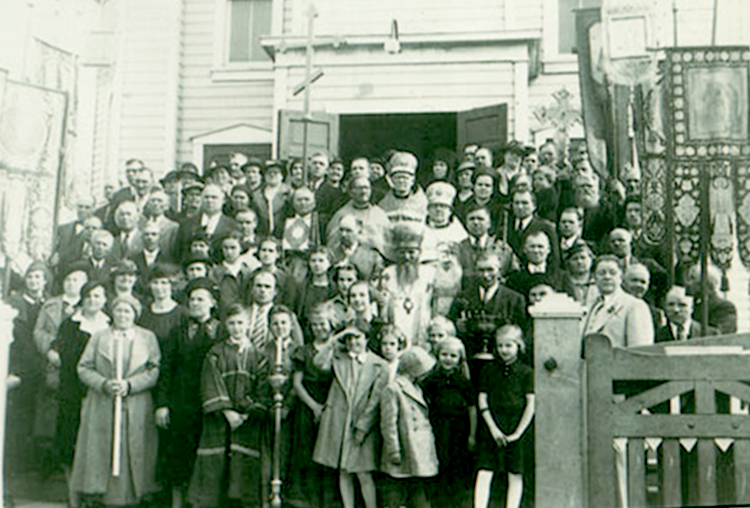
Early in 1904 Bishop TIKHON visited Winnipeg and under his powerful guidance, the early parishioners, among them Ivan Lozenko, Feodor Stefanik, K. Berezewsky, G. Butenko and Feodor Samborsky, decided to incorporate the Winnipeg church into the Russo-Orthodox administration. Services were first held in a private home on Flora Avenue. Work commenced on a building, and by 1905 the exterior was completed. The Church was consecrated by Archbishop TIKHON and given the name of the Holy Trinity. It was served by Father J. Sechinsky, Fr. M. Fikula, Fr. Skibinsky and by the tireless, energetic rector, Archimandrite Arseny, and he would later return as Bishop. The parish had members whose roots went back to Galicia, Bukovina, Russia and Carpatho-Russia. A large two-storey rectory, with room for potential theology students, was added in 1910. |

|
In 1916 Holy Trinity became the first cathedral of the Archdiocese formed in that year. Bishop ALEXANDER (Nemolovsky) the Vicar of Alaska responsible for overseeing Canadian affairs since 1913 was transferred to the Cathedral in Winnipeg, thus becoming the first resident bishop of the Orthodox Church in Canada.
Vladyka ARSENY would live and serve in that parish and from there for nearly thirty years. Light enters its windows, resting upon the Imperial golden filagree banners, a gift from Tsarist times. Historic and recent icons blend. The scent of yesteryear’s incense lingers, as light pours through its narrow windows. Here one enters into the quietness and beauty of one of the oldest urban sites of Orthodoxy in Canada. |

|
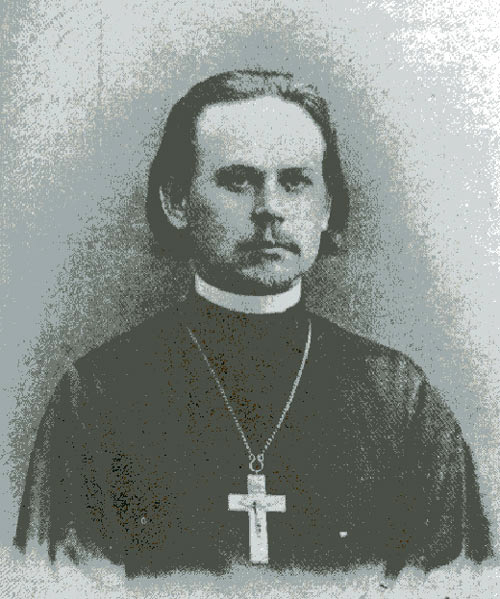
In 1915 the beginning of a seminary was made by Fr. Vladimir Sakovich here.
After some movement, its final premise, previously St. Luke’s Anglican church, was purchased in the late 1920s.
In 1923, three hundred Russian immigrants arrived from Constantinople many of whom would remain in Montreal and other of the Eastern Canadian parishes.



<vr>
Urban parishes such as this Regina one, were also formed.


Canada's cosmopolitan, bustling, ever-growing city, swelling with workers during the war years… With strong Orthodox roots built by waves of successive Russian immigration, the parish of Christ the Savior was organized prior to World War I and grew much with each successive wave of immigration following the wars. It acquired its premises during the pastorate of Fr. A. Pyza.
Priests serving after Fr. Pyza were Fr. John Wasel, Fr. Lev Silnin, Fr. A. Lisyn and Fr. K. Velma.
Many notable and talented persons have been a part of its congregation, among them the Biriukov sisters, one as architect and one as a painter, who did much for the early parish.
| This was a parish with a very broad base made up of Serbians, Russians, Bessarabians, Carpathians, Galicians, Romanians, Bokovinians, Syrians and Greeks.
In the beginning, as there was no priest the Orthodox would go to Detroit to have services have baptisms, weddings, even funerals. In 1914 organized work began in 1916 and was completed by the end of the year. First priest was Fr. Joseph Shekaley, church was consecrated in 1917 under the spiritual jurisdiction of Bishop EVDOKIM. |
|
Their first services first held in an Anglican church.
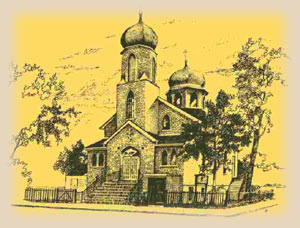
In 1918 they began building a church, which became the Bukovinian Cathedral of the Holy Trinity.

Between 1918 and 1926, over one hundred families made their way to Vancouver after the Russian Revolution. Priest Archimandrite Antonin (Pokrovsky) arrived in September, 1924, which was a great blessing to the people, and they immediately began to organize a parish. Through a variety of means, including the cultural talents of parishioners, a church dedicated to the Holy Resurrection of Christ was built and consecrated by Metropolitan PLATON in 1929.


|
Edmonton became the centre of Orthodox life in the midst of the Ruthenian settlements. The first liturgy of St. Barbara's parish was held on May 19, 1902 in a chapel in the home of Father Jacob Korchinsky.
In 1904 Bishop TIKHON visited and blessed the Church. The first temple was built in 1908. When Archimandrite Arseny became Administrator for Canada he served at St. Barbara's. "Aristocratic Russians Attend Night School to Learn Ways of the West" At the instructor’s invitation, The Herald representative visited the church one evening recently, and having entered the portals at once plunged into an atmosphere redolent of the old cosmopolitan Russia….. "The basement of the church makes no pretense to present an atmosphere in keeping with the exiles’ former mode of life. It is furnished with bare tables and benches…on one wall wreathed with paper flowers, hung a picture of the Tsar and Tsarina, flanked by another of King George….Dressed in a manner which separates them not at all from the average westerner, save for the foreign cut of the furred overcoat, a casual glance revealed that here were members of the intelligentsia. This was shortly emphasized by Mr. Hawreliak, who named each student for the writer, giving a brief outline of his or her history. Clad in a black shirt of the familiar Russian type …was His Excellency, Commandant General Gladeshiff, who during the Great War headed the armies of the Tsar at the many battles of Premyzl…Sitting next to him was a fragile little woman. She is the wife of Alexander Nezoff, famous singer at the Moscow Opera….In addition to the military element many other professions are represented in the Greek Orthodox church night school: officials of the Russian customs, stenographers, professor of languages, stenographers and teachers; all in deadly earnest to acquire the English language to fit them to earn a living in Alberta….They are being taught in a remarkably easy and commonsense manner by Mr. Hawreliak and are instructed by the use of phrases and requirements in everyday life." |